
Consumer goods is one of the broadest categories in logistics. It covers everything from frozen meals and pet food to washing machines and floor mops. Products that have almost nothing in common except that they end up in a shopping basket.
That variety is exactly what makes consumer goods logistics complex. Each product category comes with its own handling rules, storage requirements, and retailer expectations. What works for a pallet of dry pet food doesn’t work for a stack of smart TVs. And what a retailer in Belgium accepts at the dock isn’t necessarily what one in the Netherlands will.
A logistics partner that treats all this as one undifferentiated flow will create friction somewhere in your chain. A specialised one knows the difference and builds operations around it.
What logistics challenges do consumer goods brands and retailers face?
Getting consumer goods from factory to shelf sounds straightforward. In practice, the supply chain between those two points is full of variables that compound quickly.
The key logistics challenges across consumer goods categories are:
- Inventory complexity: Consumer goods ranges change constantly. New product launches, promotional SKUs, and phasing out older stock all happen simultaneously. Without tight inventory management, slow-moving stock occupies space that active lines need.
- Product variety within one operation: A single client may ship food products, cleaning supplies, and fragile goods under the same contract. Each product group has different handling rules, stacking requirements, and storage conditions. Managing that mix without errors requires structured processes and trained teams. A good example is pet care: a brand like Tom&Co ships dry food, wet food, and pet accessories. Each of those product types follows different handling and storage rules, yet they move through the same warehouse.
- Seasonal peaks: Promotions like Black Friday and the end-of-year period drive volume spikes across every consumer goods category. Storage demand rises, shipment frequency increases, and transport networks come under pressure. The combination of high volumes and diverse product types makes planning and flexibility non-negotiable.
- Cross-border complexity: Selling across Belgium, the Netherlands, and France means different labelling requirements, retailer expectations, and regulatory standards. WSC’s locations in Liège and Limburg and the south of Belgium make us a natural link to neighbouring markets, with the operational expertise to match.
Each of these challenges is manageable on its own. Stack them together and consumer goods logistics becomes a category that rewards experience and punishes generic approaches.
Why do consumer goods need a specific logistics approach?
Consumer goods logistics requires specialised knowledge because product categories vary enormously. And what works for one doesn’t work for another:
- Food & FMCG like fresh and frozen foods, beverages, and fast-moving products like personal care and skincare often require temperature-controlled storage and strict rotation rules. FEFO – First Expired, First Out – isn’t optional. A pallet shipped in the wrong sequence can mean unsellable stock at the retailer’s end.
- Pet care like dry food, wet food and accessories sound straightforward until you’re managing the SKU range of those brands. The same FEFO rules apply for pet food as well. Accessories bring fragile packaging, mixed pallet builds, and the picking complexity that comes with dozens of variants across sizes and species.
- White goods like washing machines, refrigerators, and ovens demand careful palletizing, correct stacking heights, and secure fixation during transport. Wrong stacking or insufficient securing quickly leads to damage before reaching the store.
- Brown goods like TVs, smart speakers, and small electronics are more compact, but the challenge lies in SKU mixes and packaging formats. In a warehouse full of pallets with dozens of variants, wrong order picking risks are real and costly.
- Household & cleaning supplies like mops, brushes and other cleaning tools aren’t fragile in the way food or electronic goods are, but their packaging is. Shrink-wrapped multipacks and retail-ready units, dent and tear easily during handling, and a damaged outer means a product that can’t go on shelf. Bulk volumes and irregular shapes add another layer to efficient storage.
A logistics partner that treats all these categories as one undifferentiated flow will create cost somewhere in your chain. The question is whether that cost shows up as damage, as picking errors, or as retailer chargebacks.
How Weerts Supply Chain works with consumer goods brands and retailers
The real complexity in consumer goods logistics isn’t only inside the warehouse, but at the interface between your operation and the retail partners you ship to. Every major retailer has its own delivery specifications, and a single missed requirement can mean a refused delivery and a chargeback.
Our operations are built around the delivery requirements of the major retailers our clients ship to. For each destination, we adapt the relevant steps in our process:
- Sorting and palletising to retailer specification, including stretch wrapping to the required standard and retailer-specific pallet heights, because what passes at one chain is grounds for refusal at another
- EDI messaging and DESADV notifications to confirm shipments electronically and book delivery slots through retailer portals before the goods leave the warehouse
- Proactive contact when delivery issues arise, so the retailer hears from us first and you don’t get the chargeback conversation after the fact
- A real-time client portal powered by our in-house Warehouse Management System, with live ETA, order status, proof of delivery, and live stock visibility, so you always know where your goods are
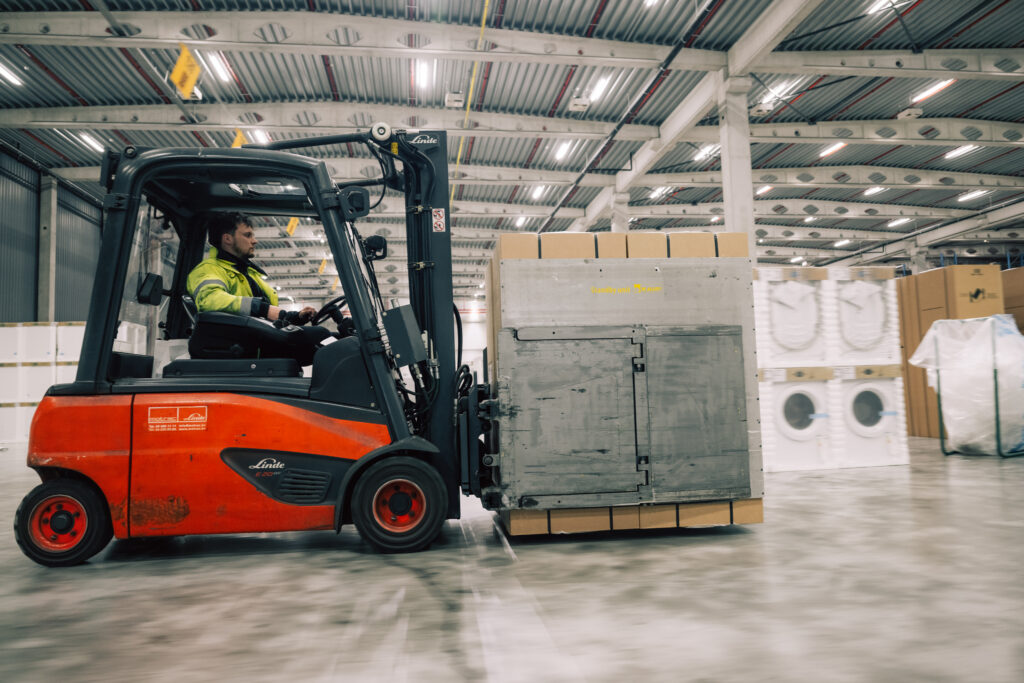
- Specialised handling equipment per product type: not every product arrives on a standard pallet or can be moved with standard equipment. We use specialised clamp trucks with monitored clamp pressure for unpalletized goods, so fragile casings and packaging are moved without the impact of damage that standard handling causes.
The value-added services we provide for consumer goods brands
Beyond moving goods from A to B, we provide the value-added services that make the difference when handling consumer goods:
- Packaging repair and reworking: when a unit arrives with cosmetic packaging damage from transit, we restore it to sellable condition rather than sending it back to you or writing it off
- Storage flexibility around retailer schedules: when major retailers pause deliveries during holiday periods or system freezes, we hold your stock until their warehouses reopen, so your production doesn’t have to stop
- Hold-and-release orders on request: we can stage shipments and release them when you want them dispatched, so you can align deliveries to your own commercial timing
- Storage handling aligned to your product rules: we follow your storage instructions and product pictograms exactly, so handling rules travel with the goods rather than getting lost between teams
- B-stock and second-choice stock management: products that can’t be sold as new (because of minor damage, returns, or open packaging) are stored and tracked separately, so you can sell them through outlet channels or secondary markets without contaminating your main stock
- Returns handling and refurbishment: including appointment booking for return pickups, condition grading, and compliant disposal where needed.
The combination of retailer-aligned operations and flexible value-added services is what separates a logistics partner who absorbs your complexity from one who passes it back to you.
Consumer goods logistics: a chain link you don’t leave to chance
Consumer goods logistics is rarely one big problem. It’s a stack of details that look manageable individually until one of them goes wrong and exposes the rest. The broader your product range, the more places that can happen.
A logistics partner who knows the sector, understands your product groups, and aligns operations to your retail partners’ specifications makes the difference between a smooth chain and one that needs constant attention.
Ready to partner with someone who stores and transports your products correctly?
Curious what Weerts Supply Chain can do for your consumer goods? Contact us for an informational conversation.


