
Interview with Amine, Data Analyst at Weerts Supply Chain
Behind every package that ships on time, lies a stream of accurate data. Amine has been working as a data analyst at Weerts Supply Chain in Liège for a year and is responsible for that stream of data. He connects systems, transforms data, and ensures that warehouses and customers are always on the same page. It’s a job that rarely takes center stage, but is essential to keep operations running smoothly.
We spoke with him about his daily work, the invisible impact of data, and why logistics has actually fascinated him his whole life.
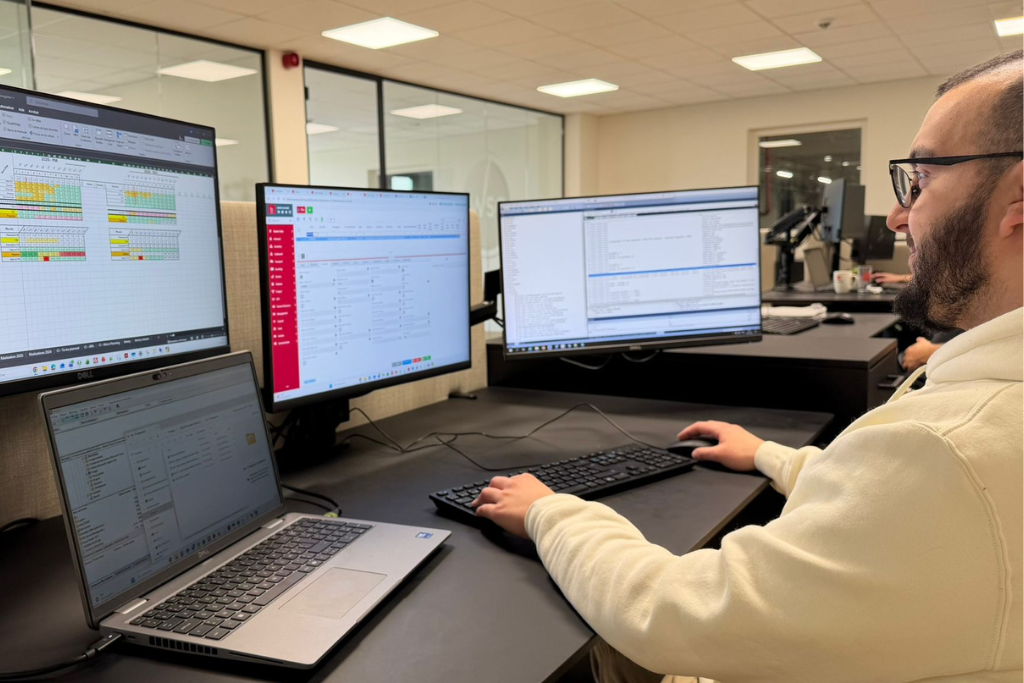
You discover something new every day. This job gives you the opportunities to keep learning.
– Amine, Data Analyst at WSC
Why Amine chose a career in logistics
Amine grew up with logistics. Not as a concept, but as a daily reality. “My father works in that sector,” he explains. “It’s a passion that’s been passed down from father to son.” For him, logistics was never a random choice, but a path he’d always had in mind. “It was always a goal in my life to work in that field.”
His path to Weerts Supply Chain led through a previous logistics position at a competitor. When he saw the job opening, he didn’t hesitate for long. “The industry appealed to me, so I just applied.” He’s been working here for a year now, and the dynamic nature of the field keeps him captivated.
What does a data analyst do?
A data analyst in logistics connects systems, transforms data sources, and ensures that information automatically reaches the right destination. “My job involves connecting different systems,” Amine explains. “It revolves around sending and receiving data, transforming it, and cleaning it up as much as possible for our system and for the customer’s system or that of another company.”
In practice, he works with file formats such as CSV, Excel, and EDI. These are converted into usable data for the logistics chain. An important part of these are maps: interfaces that automatically send a message when something happens in the warehouse. “When an order receives the ‘complete’ status, that triggers a map that notifies the customer that the order is ready to be shipped,” Amine explains. “That way, no one has to follow up on it manually, because the system does it on its own.”
What does a typical workday look like for a data analyst?
There’s no set daily schedule. What the day entails depends entirely on what comes in. “It can range from support to implementing maps, to data management and data transformation,” Amine explains. “The only constant? The morning coffee ritual”, he says with a laugh.
It’s precisely that variety that makes his job exciting. “Every day you discover a new feature or new information you didn’t know before. It’s a pretty dynamic field. Quite simply: it lets you learn something new every day.”
When priorities need to be set, it’s based on two criteria: the deadline and the impact on the business. “You just take it one task at a time, look at the priorities first, and work in a way that doesn’t let the pressure build up too much.”
Direct impact on the warehouse
Data analysts work largely behind the scenes, which sometimes creates a distorted view of their role. “People mainly know the developers, the people who create the software,” says Amine. “But they often forget that there are people working behind the scenes who prepare that data so the developers can build the software.”
The impact is more tangible than many people realize. Amine receives orders and advance notifications that warehouse staff use to prepare incoming and outgoing shipments. If something goes wrong on his end, the entire warehouse feels it immediately:
If there’s a problem on our end, you could say the warehouse comes to a standstill.
At the same time, his work also delivers real operational benefits. Processes that used to have to be carried out manually are now fully automated. “This has allowed other employees to focus on other things and take on different tasks.”
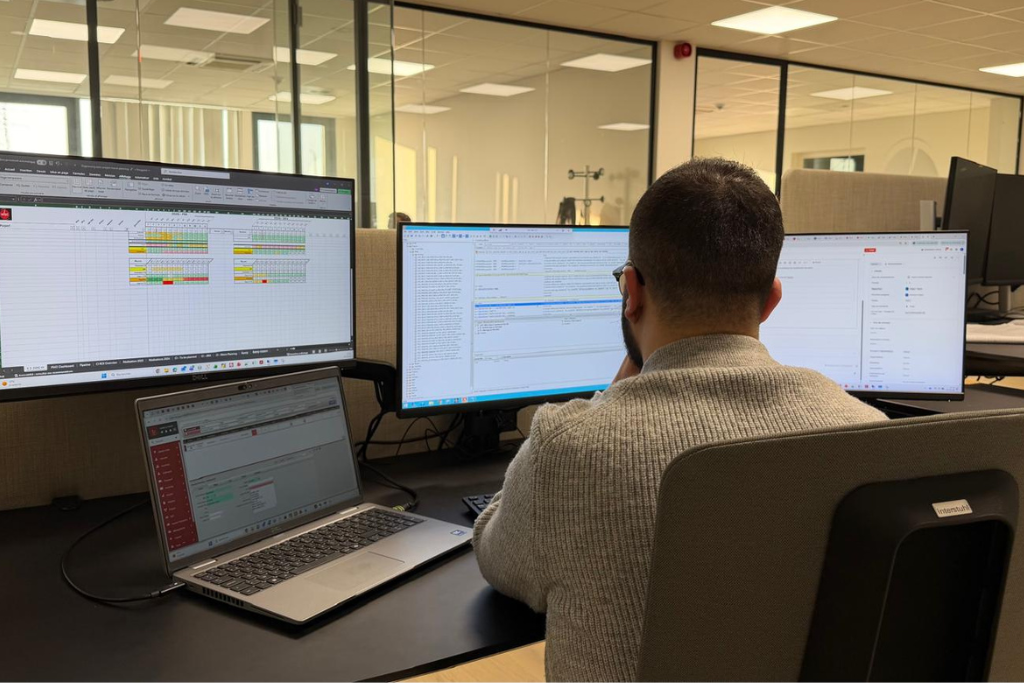
From report to action: how data improves operations
In addition to technical data management, Amine also handles reporting and analysis. A concrete example is a dashboard that tracks which trucks arrive on time and which do not. “Using all the Power BI reports, we can show which carrier arrived late, by how many minutes, and whether they arrived on time or not.”
How does data analysis improve warehouse operations?
The data analyst provides the operations team with the information they need to make adjustments. “I make sure that operations has access to the data that helps them manage operations more effectively,” says Amine. “Based on those insights, they can engage with carriers who are consistently late and follow up to see if there’s any improvement.”
For Amine, that’s exactly the difference between merely reporting and making a real impact. “When you create a report that’s operationally useful, you know that what you’re doing helps the company run smoothly. And that simply gives your work recognition.”
Building bridges between IT and operations
Working with people who have little or no data expertise is an essential part of Amine’s job. “We need to understand the business side of things. We have to translate their business-related questions into requests for data modifications or adjustments.” It’s up to him and his colleagues to understand the needs of the operational teams and develop the right technical solution to meet them.
His daily interactions are diverse: clients and their data analysts or project managers, but also employees on the shop floor who report a problem. “Usually, we exchange client files or information and check in to make sure everything went smoothly. And if there’s a problem, the employees contact us.”
Delta Tool and Power BI: The Technology Behind the Analyses
In the field of data analysis, technology isn’t just a supplementary tool—it’s the foundation itself. “Technology is essential in my field,” Amine says bluntly.
The two tools he uses every day:
- Delta-tool: for building data maps and automated data flows between systems
- Power BI: for dashboards, reporting, and operational insights that the team can use without having to work with raw data themselves
This combination enables him to both manage the technical data connections and make the results transparent to the rest of the organization.
The invisible link that keeps the company running
When asked how he would describe his own role, Amine is clear: “The data analyst is a crucial role in a transportation or logistics company. Even in other sectors.” It’s a position that’s rarely recognized, but one that enables an organization to run as it should.
“It’s a rewarding role, and it ensures the company can function effectively.” For someone who knew from a young age that he wanted to work in logistics, this feels like exactly the right place.
Your career in logistics
Did this interview with Amine inspire you to pursue a career in logistics? From data analyst to warehouse manager, as long as you’re eager to work in logistics, Weerts Supply Chain has roles for every skill set.


